
Digital sovereignty and global partnership: A strategic vision for the future of Europe
As United States dynamics shift toward interventionism, Europe must lead in securing new strategic partnerships
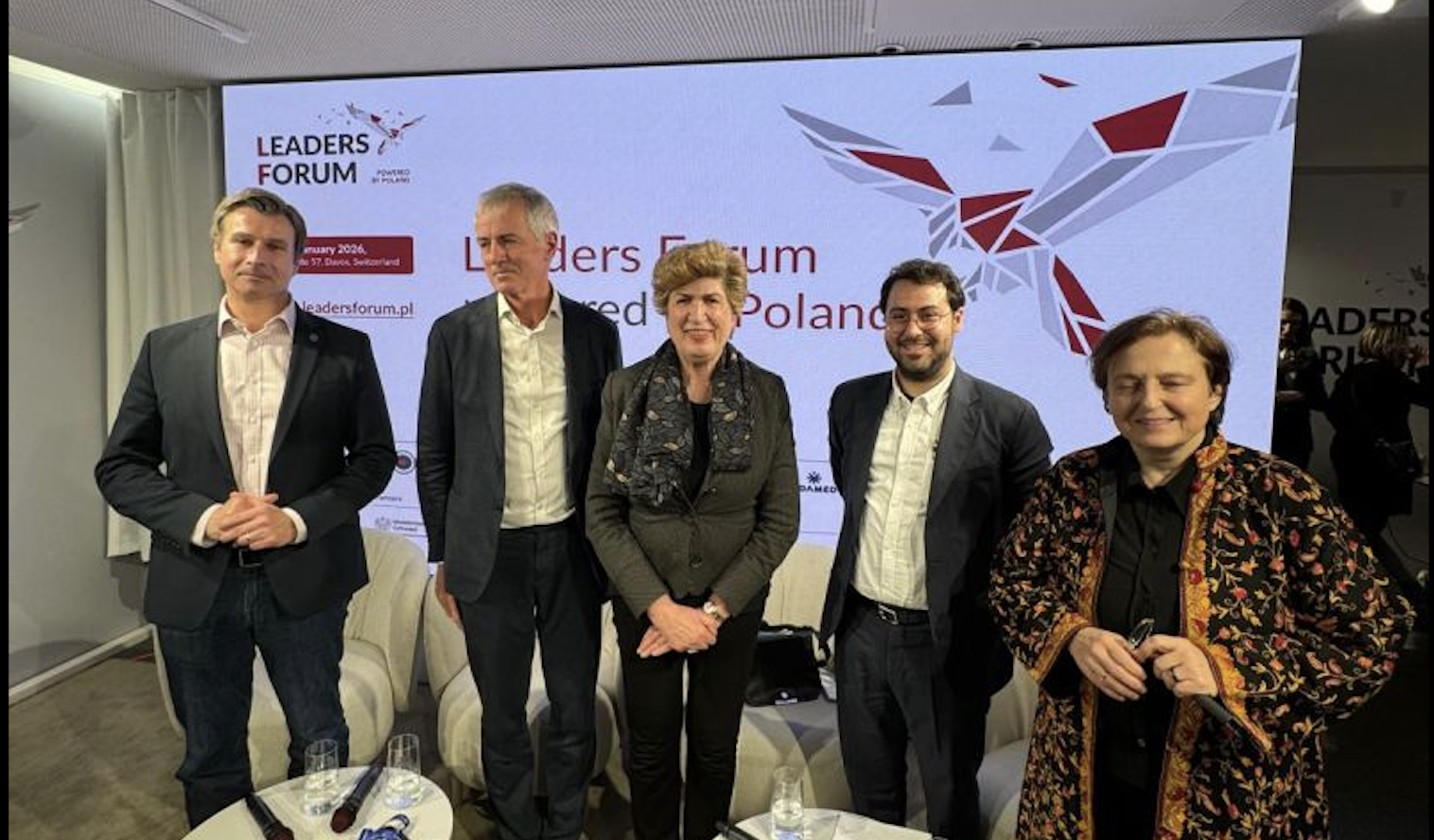
In a geopolitical landscape increasingly defined by a sharp interverventionist turn from the new Trump Administration, Europe finds itself at a defining crossroads. Yet, rather than succumbing to the fragmentation of the world into spheres of influence , Europe has the opportunity to promote a new generation of strategic global partnerships to foster more international cooperation to address the existential challenges of our time. This was the heart of the message delivered by Maria João Rodrigues, Chairwoman of Re-Imagine Europa, during her interventions at the AI House and the Leaders Forum’s events organised during the World Economic Forum in Davos. Speaking on the panel “Science Diplomacy: Advancing International Cooperation through Research and Innovation“ of the Leaders Forum, Rodrigues articulated a vision where Europe’s strength is measured by its inclusive democracy and the breadth and resilience of its networks. “Digital sovereignty is an absolute imperative for the future of Europe, yet it must go hand-in-hand with deepened international cooperation”, she argued. “Europe must lead the way towards the future by building a new generation of strategic partnerships.”
Rodrigues detailed tha “the European Union have concluded that it is not enough for us to regulate the digital transformation. We also need to build our own digital capacity, we need to innovate, to come up with new solutions”. She clarified that digital sovereignty “doesn’t mean not cooperating with the world. On the contrary, she added, we also need more international digital cooperation”and building up an European Digital Diplomacy”. “At the end of the day, she said, what is a stake is what should be the global architecture for digital transformation and AI. We have two big technological poles, the United States and China, but many countries don’t want to follow the American or the Chinese models. They want to try their own model, aligned with their own needs. Europe is part of this movement towards more digital cooperation to develop new digital ways”.
Mobilizing private and public investment
Rodrigues emphatized that materialising this vision requires the strategic deployment of the EU Research and Development funds, to foster long-term resilience and keep Europe at the frontier of innovation. Rodrigues called for the European Investment Bank and the EU budget to act as catalysts to keep these champions rooted in European soil, ensuring they strive as European entities within a globalized market. Without it, Europe risks seeing its most groundbreaking companies bought by foreign investors, eroding the very sovereignty it seeks to build. Yet, public funding is only part of the equation.She alerted, “private investment is absolutely vital” to this strategy notably using the capital market union to fund and scale up innovative companies. Because if we don’t tackle this problem, these European companies will be bought by the big American ones”.
Building on the strenghts of the European market, “we need to build an apetite from European citizens to buy European solutions focusing on sectors such as agri-food, manufacturing, mobility, public services,health and education”. “In all these areas, she explained, Europe can cooperate with other countries. We see that other countries in Latin America, Africa, Asia, in the Gulf Area also have ambitious programs to make the most of digital transformation. I believe, she added, that we have now a unique opportunity for an exchange on concrete solutions for these sectors”. “What we are defining now is a new digital civilization. And this new civilization requires a lot of international cooperation”, Rodrigues concluded.
Supported by the Centrum Stosunków Międzynarodowych, THINKTANK, and leading Polish partners, the Leaders Forum powered by Poland brought together international experts and global leaders from business, politics, and academia. These critical dialogues align closely with Re-Imagine Europa’s strategic priorities, sitting at the heart of our work to
define a new horizon for the European project, fostering global governance and advancing the principles of digital democracy. We remain committed to ensuring that Europe’s sovereign future is built upon a foundation of human-centric technology and enduring international partnership.
In the picture, from left to right, the panelists Robert Grey, Chancellor of the University of Warsaw, Karel Lannoo, Chief Executive of CEPS (Centre for European Policy Studies); Maria João Rodrigues EU; the moderator Tarek Ali Ahmad, Head of the Arab News Research & Studies Unit at Arab News; and Dr Malgorzata Bonikowska, President of the Centrum Stosunków Międzynarodowych and Co-founder & President of THINKTANK.