Narrative Intelligence: Repairing the Fragmentation of Meaning in a Polarised World

We live in a time marked not just by social and political polarisation, but by a profound fragmentation of meaning. The same words can mean entirely different things for each individual, depending on the narrative community they belong to. When one community hears the phrase ‘Climate Action’, they envision a blueprint for resilience and future-proofing; while others hear sacrifice, economic disaster and elite overreach. The same words trigger totally different emotions, impeding any constructive dialogue before it can even start. This isn’t just a failure of communication: it is a fundamental collapse in how we perceive and understand reality itself.
As we look back on 2025, Re-Imagine Europa (RIE) has met this challenge partnering with a wide range of public and private institutions to dismantle highly polarised discourses, crafting new, more open and inclusive narratives to foster more effective communication and constructive dialogues.
Behind every policy, industry or social deadlock lies a clash of lived experiences with deep ingrained beliefs about who are the heroes and the villains of the reality surrounding us. Re-Imagine Europa’s innovative Narrative Research and Methodology show us how to decipher these mental frameworks, discover the narrative traps that often block our vision and construct narrative bridges to forge shared solutions to the most pressing challenges of our time.
Our work this year has transcended mere narrative mapping and analysis; it has been an exercise in social repair, reconnecting fragmented truths to forge a more resilient and united European project.
Decoding the Friction: from Agriculture to AI
In 2025, we worked with an extended network of stakeholders to foster inclusive, multistakeholder platforms to bridge divides between science, policy, and practice in fields as diverse such as agriculture, biotechnology, climate, Artificial Intelligence, and Official Development Aid.
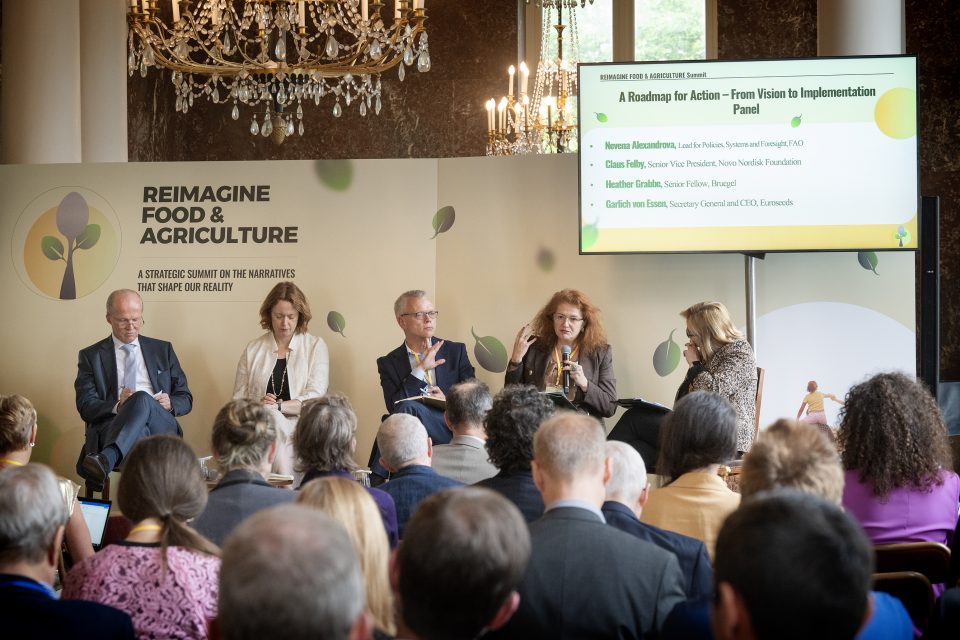
The 1st Strategic Food Summit hosted by RIE brought together a diverse coalition of partners and key actors from European institutions to co-create shared language around sustainability, aligning goals across sectors, and moving towards a more resilient and equitable agri-food future. The event, hosted at the European Parliament and the Royal Flemish Academy of Belgium and Science and the Arts (KVAB), finalised with a call for smarter use of existing tools, build on trust, transparency, and long-term strategic thinking rather than new regulation.
2025 also marked the launch of the RECAP Project, an initiative co-funded by the European Commission to bring the Common Agricultural Policy (CAP) closer to the European citizens. RECAP will deploy an ambitious narrative and communication strategy to built more inclusive and constructive dialogues around a policy that is central to ensuring food security, supporting farmers, fostering balanced rural development, and advancing sustainability objectives such as biodiversity protection and climate action.
Simultaneously, Re-Imagine Europe’s work on Biotechnology has contributed to build a new framework for legislative on new genomic techniques, addressing innovation in agriculture through targeted research and stakeholder dialogue. Our work contributed expert insights to ongoing legislative discussions and explored practical case studies on regulatory simplification, highlighting how innovation can support a more competitive, sustainable and resilient European agricultural sector.
Data, AI and Governance
In the digital sphere, Re-Imagine Europa reinforced its role at the vanguard of digital governance and ethics in Europe. Through 2025, our Chief Executive, Erika Staël von Holstein, continued to contribute her strategic perspective to key advisory bodies shaping Europe’s future, including the Spanish Government’s International Artificial Intelligence Advisory Council and the EU Science Diplomacy Working Groups, where she works to bridge the gap between scientific innovation and the diplomatic foresight required for a stable European future.
As discussions on AI, data governance and democratic resilience took centre stage, the SoBigData Preparatory Phase Project (SBD PPP) ensured that big data analysis generates social and policy-relevant insights, positioning data as a key democratic resource rather than a mere economic asset.
Re-Imagine Europa acted as a key bridge, transforming complex research on societal debates, misinformation, and digital narratives into accessible outputs for policymakers and stakeholders. This work fed evidence-based discussions on EU priorities such as the AI Act, shifting attention toward governance, accountability, and public value. The foundations laid in 2025 position SBD PPP to support Europe’s next phase of digital governance.
With AI4Gov-X, we witnessed a shift from merely regulating technology to actively enabling it. The project focuses on strenghening skills, capacities, and communities for democratic and effective AI adoption. Through a series of workshops, alumni engagement, and flagship events like the AI4Gov Open Event in Brussels, the project is consolidating a growing European network of civil servants, researchers and practitioners experimenting with AI in real-world contexts. By cultivating a European network of civil servants and researchers, we are ensuring that the adoption of AI in public administration is driven by accountability and public value, rather than just efficiency.

Building a stronger democracy
Reinforcing trust and transparency, fostering deliberative democracy and connecting policymakers with citizens, are the main goals of other ambitious EU initiatives with participation of Re-Imagine Europa participates such as: Re-Imagine Europe: Reimagine Food & Agriculture 2025
Orbis, a Horizon Project led by Politecnico di Milano that culminates in 2026. Orbis responds to the profound lack of dialogue between citizenship and policymakers with socio-technical solutions to enable the transition to a more inclusive, transparent and trustful deliberative democracy in Europe. The project brought together a rich pool of technical and social science experts to produce new research, methodology and technical solutions building on existing tools –from the deliberation deliberation platform bCause (developed by The Open University) to the tool for mining arguments in the US presidential elections DISPUtool (CNRS), or the Community Engagement Against Radicalization project (CSI).
NEUROCLIMA, an EU-funded project to promote and support the EU Adaptation Strategy by raising citizen’s awareness about climate resilience strategies and building a nervous system that connects policymakers, public institutions, and citizens through innovative tools that combine Artificial Intelligence and human capabilities. The initiative will provide new tools, best practices, frameworks, and concrete solutions directed to key societal actors –researchers, schools, universities, journalists and content creators, policymakers, etc. Besides two pilots to assess the impact and applicability of proposed innovations, NEUROCLIMA will deliver three toolkits for stakeholders and citizens on participatory design, creative writing, cinematography, animation and performing arts. These toolkits will foster inclusive and widespread participation, educate citizens of all ages, nd facilitate participatory workshops to disseminate EU climate initiatives.
MultiPoD, a three-year Research and Innovation initiative funded by the European Union under the Horizon Europe programme, aiming to transform democratic participation by bridging cultural and linguistic divides, empowering marginalised voices, and redefining the digital landscape of participatory democracy. The project seeks to create a multilingual and multicultural European public space for political deliberation, combining online and in-person formats with advanced technologies like Generative AI. Visual tools and analytics help policymakers and professionals understand patterns in political communication, detect potential biases, and support more transparent and inclusive democratic processes.
Building on this momentum, Re-Imagine Europa enters 2026 with an unwavering mission: to help shape the digital and social architecture of a stronger, more resilient, united Europe. Central to this work will be the deployment of our Narrative Research and Methodology to support public and private institutions in mending the fragmentation of meaning that often paralyse the most critical conversations about their strategies. By serving as the connective tissue between scientific rigor, actionable policy recommendations and true citizens engagement, we are ensuring that Europe’s most vital transitions are built on a foundation of shared understanding.