
Beyond Fact-Checking: The Stories That Shape Our Understanding of the World
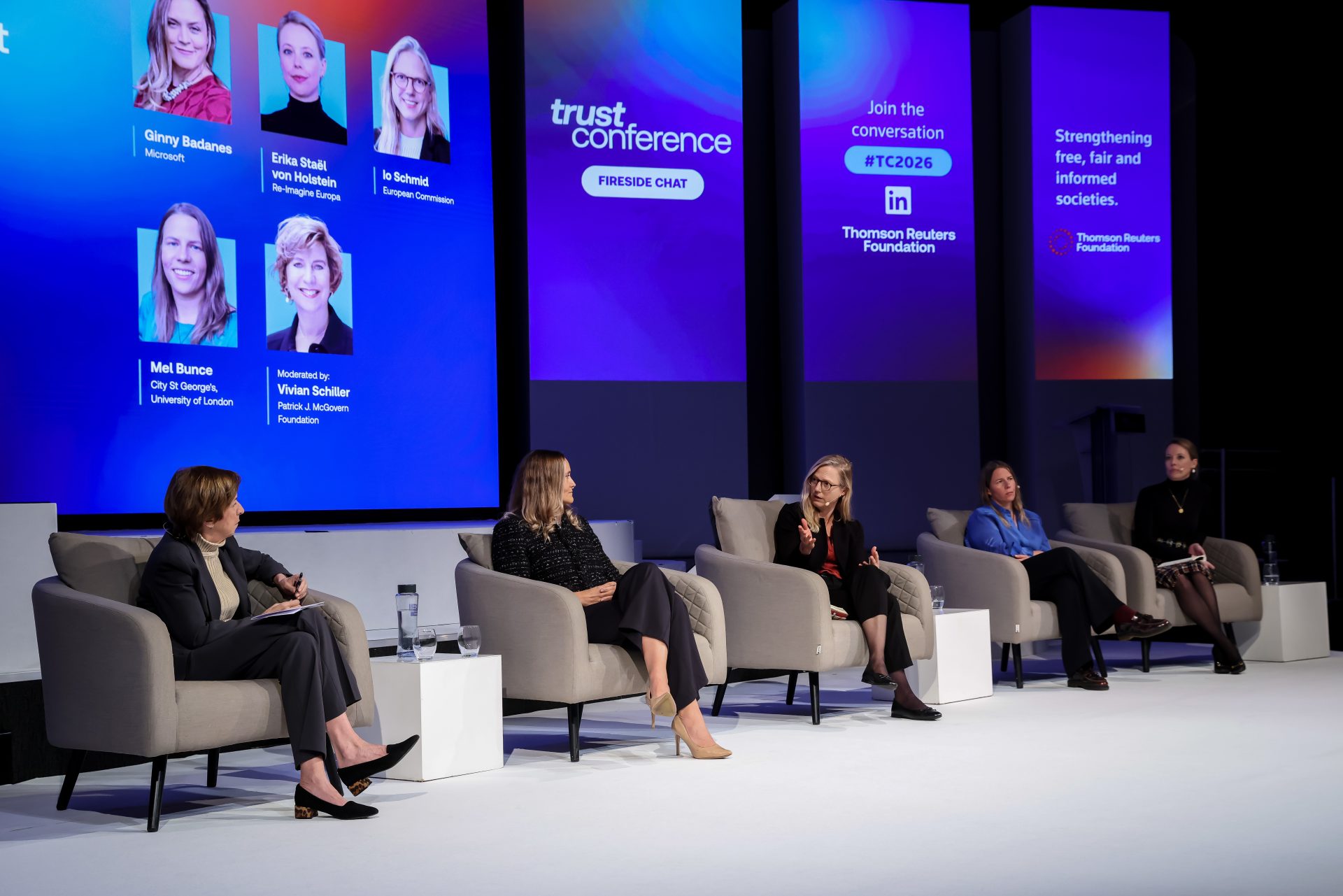
Why is correcting false information rarely enough to change someone’s mind? At the 2026 Thomson Reuters Foundation Trust Conference, Re-Imagine Europa’s Co-Founder and CEO Erika Staël von Holstein examined how the internal narratives people use to make sense of the world shape their reading of the facts – and why recognising these stories is essential to countering disinformation and strengthening democracy.
When people disagree, we often assume that the solution is to give them better information. Present the facts, correct the errors, and the misunderstanding should disappear. Yet two people can look at the same piece of evidence and reach completely different conclusions.
The reason, Staël von Holstein argued, is that nobody processes information in a vacuum. People filter new data through the stories, experiences, and beliefs they already hold. As she put it: “We’re usually not fighting about the facts; we’re fighting about what the facts mean, and they mean different things to different people.”
Understanding this distinction is crucial to understanding why disinformation can be so effective.
Why some messages find an audience
Disinformation does not always work by persuading people of something entirely new. More often, it succeeds because it connects with something they already thinks to be true.
“Good disinformation campaigns don’t implant an idea in your brain. They activate one that is already there,” Staël von Holstein said. A claim lands much harder when it validates an existing worldview. That is why debunking a falsehood often falls flat: even after the specific claim is dismantled, the underlying belief that made it plausible stays intact.
Staël von Holstein compared this dynamic to a Trojan horse. While fact-checkers and critics focus on disputing the surface-level claim, a much stickier underlying message slips past unnoticed.
The challenge, therefore, is not only to identify false information, but also to understand why certain messages feel credible. What concerns do they speak to? What experiences do they reflect? And what wider story do they reinforce?
Finding common ground between different perspectives
If people interpret the world through different stories, how can conversations move beyond disagreement? As Erika explained, the first step is to understand the perspectives behind a debate rather than immediately trying to change someone’s mind.
She illustrated this through the example of farmers and environmental organisations. At first glance, the two groups may appear to be on opposing sides. Yet they can share important assumptions: both may feel that the current system is unfair and needs profound change.
Their visions of what a better future looks like, however, can be very different. One may look towards the future, while the other draws inspiration from the past. The disagreement is not necessarily about the desire for change itself, but about what that change should look like.
Recognising this common ground can open up a different kind of conversation. Erika described the importance of creating narrative maps to understand the different stories at play, and narrative bridges to help people find connections between them.
The objective is not necessarily to change someone’s mind. As she explained, “what you can do is to bring the conversation to where there is a commonality.” This requires curiosity and a willingness to listen. It also means recognising that people who appear far apart may sometimes be approaching the same problem from different perspectives.
Why different voices matter in the age of AI
These questions become even more important as artificial intelligence increasingly shapes how people access information.
During the discussion, Erika highlighted the importance of ensuring that AI systems reflect a diversity of perspectives. If they draw on an information environment dominated by a limited set of viewpoints, they risk reproducing that narrow perspective and making other voices less visible.
This makes a diverse media landscape essential. Journalism and information sources need to represent different experiences, cultures and ways of understanding the world. A healthy democracy depends not on everyone thinking alike, but on people being able to encounter different viewpoints, question their assumptions and engage with others.
Ultimately, strengthening information integrity means more than providing accurate facts. It also means understanding the beliefs and experiences through which people interpret them, and creating opportunities for dialogue across different perspectives.
As Erika concluded: “We should learn to see disagreement and diversity as our biggest strength.”
In a world increasingly shaped by competing narratives and AI-driven information systems, protecting that diversity is essential to building a more resilient democratic society.