
Climate Action at a Crossroads: Navigating the Narrative Architecture as COP31 Begins
As the 31st UN Climate Change Conference (COP31) opens in Antalya today, diplomats, negotiators, and institutional delegates are once again gathering to calibrate global commitments. These high-level summits remain indispensable anchors of multilateral alignment – establishing the overarching trajectories and diplomatic baselines without which coordinated international action cannot proceed.
Yet anyone working closely with climate governance knows that international agreements are only as durable as the systems supporting them on the ground. Delivering a successful transition requires aligning an immense matrix of moving parts: mobilizing adequate financial instruments, deploying clean technologies, reforming regulatory frameworks, managing infrastructural shifts, and addressing acute socio-economic inequalities.
Even when financial and structural tools are successfully brought to the table, implementation often stalls, entangled in highly conflicting and polarising negotiations. As research from the 1st European Narratives Observatory (NODES) shows, the frictions of the green transition are deeply shaped by how climate information is understood by different narrative communities and how these communities react emotionally to the information received. In recent years, the weaponisation of climate-related narratives by key social and political actors has been one of the main sources of polarisation across societies.
Decoding the Climate Discourse: NODES Perspective
Through the European Narratives Observatory combatting Disinformation in Europe Systemically (NODES)—led by Re-Imagine Europa—our ongoing research into European climate discourse has laid bare a recurring pattern: polarisation around ecological transition rarely stems from a fundamental rejection of scientific fact. Instead, it arises from how the same data are interpreted through entirely distinct cultural lenses and cognitive frameworks by different Narrative Communities.
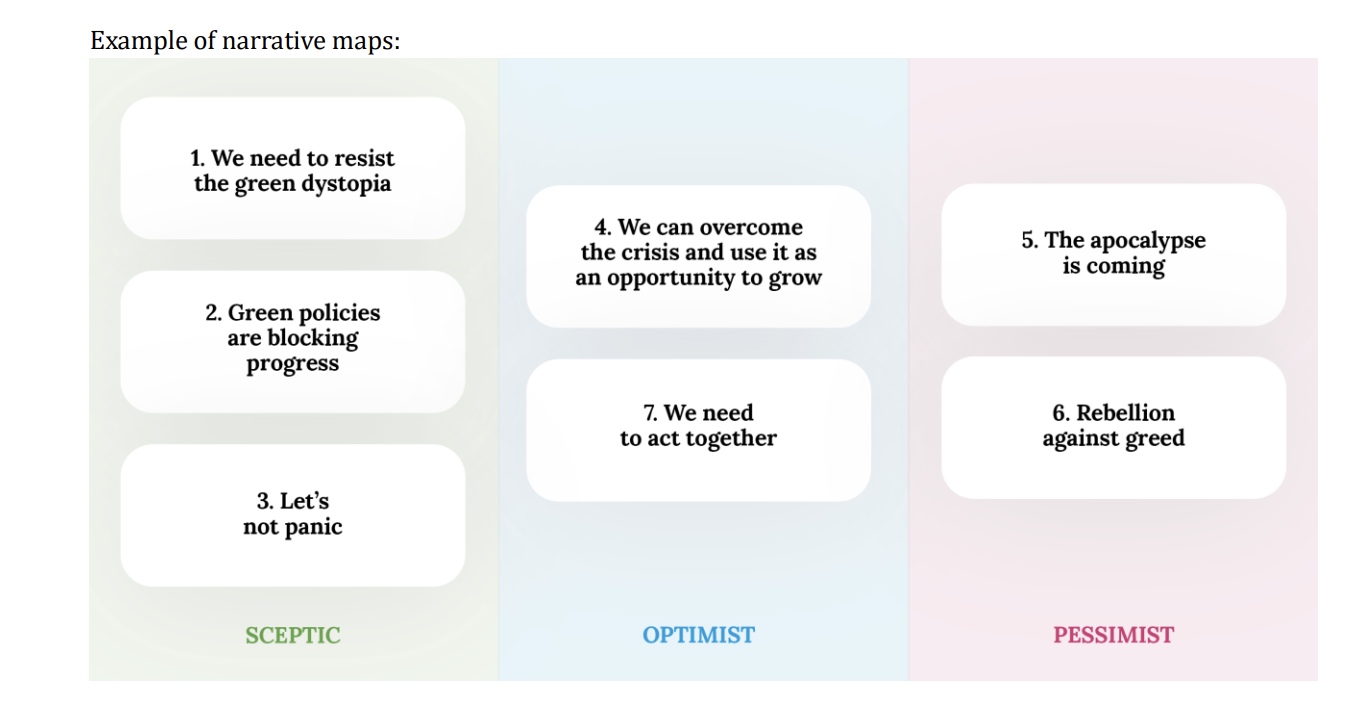
The same policy announcement regarding energy restructuring or resource allocation can evoke radically divergent emotional responses depending on the narrative community receiving it. When the public conversation leans too heavily on technological innovation or alarmist urgency, cognitive traps quickly form. These invisible pitfalls distort meaning, flatten nuance, and are routinely weaponized to cast the transition as a zero-sum conflict – pitting rural livelihoods against urban mandates, economic competitiveness against environmental stewardship, and generational responsibilities against immediate survival.
Dismantling this gridlock requires more than superficial fact-checking or algorithmic content moderation. It demands a systematic diagnosis of how meaning is constructed across different societal segments.
From Polarisation to Shared Agency: The REFRAME Methodology
If we intend to bridge the gap between abstract policy design and everyday civic reality, we have to approach public dialogue with sharper analytical tools. This realization led Re-Imagine Europa to develop the REFRAME Methodology—a structured, evidence-based approach designed to navigate polarized public debates and identify the underlying values that connect opposing groups.
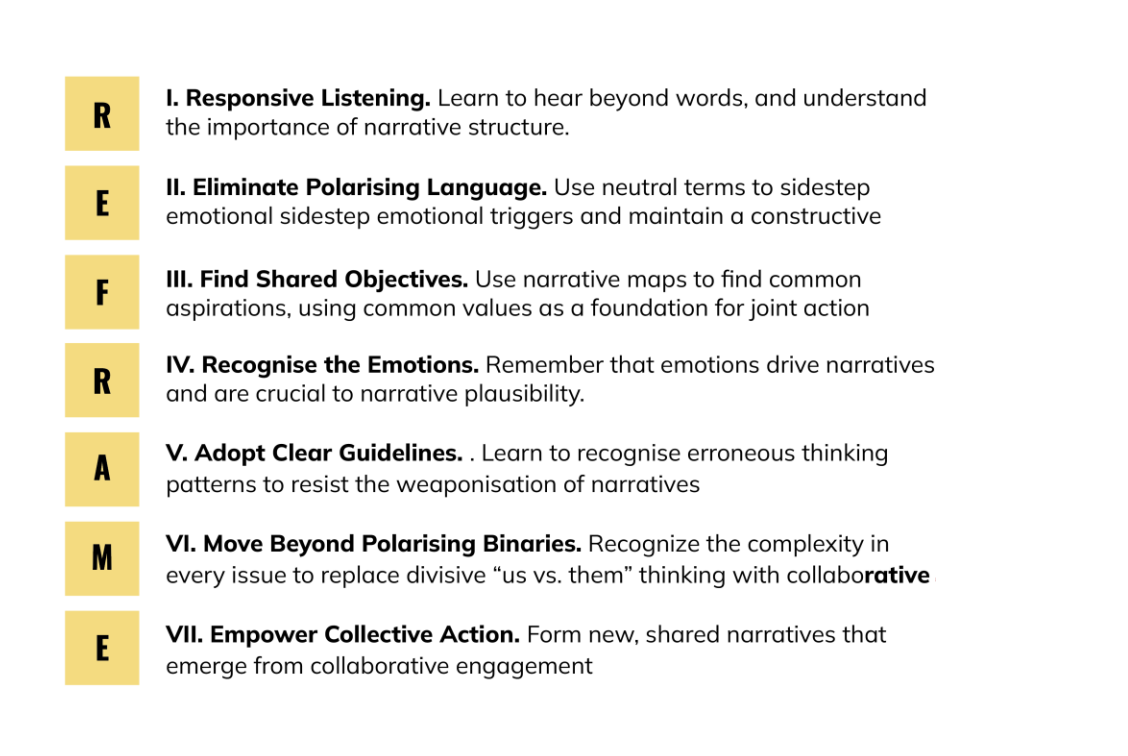
Rather than treating disagreement as an intractable barrier, REFRAME enables researchers, policymakers, CSO experts, media organisations, and all kinds of public and private institutions to look past surface-level hostility and locate the narrative bridges capable of grounding constructive dialogue. By mapping shared concerns and fostering structured, empathetic exchange, this framework helps transform emotionally charged confrontation into practical conversations about mutual solutions.
Fostering climate adaptation through Neuroclima
Intellectual frameworks and narrative analysis achieve their true value only when they meet the realities of ground-level implementation. At Re-Imagine Europa, our commitment to connecting policy, research, and people also extends to our participation in EU-funded initiatives such as the Horizon Project Neuroclima, where we lead the Communications efforts.
By blending behavioral sciences, Social Tipping Points, AI-driven technology and dozens of creative tools and activities, Neuroclima has worked with thousands of citizens in deploying localised pilots to move from climate awareness to building climate adaptation. Neuroclima provides researchers, regional journalists, educators, and local authorities with the practical tools, and framework needed to co-create climate resilience from the bottom up.
As global discussions unfold in Antalya over the coming days, the central challenge before us is not merely what governments promise inside the conference halls, but how we cultivate the shared understanding required to bring those commitments to life across our communities.