
Redefining Europe’s Partnership to foster Competitiveness and Sustainable Growth
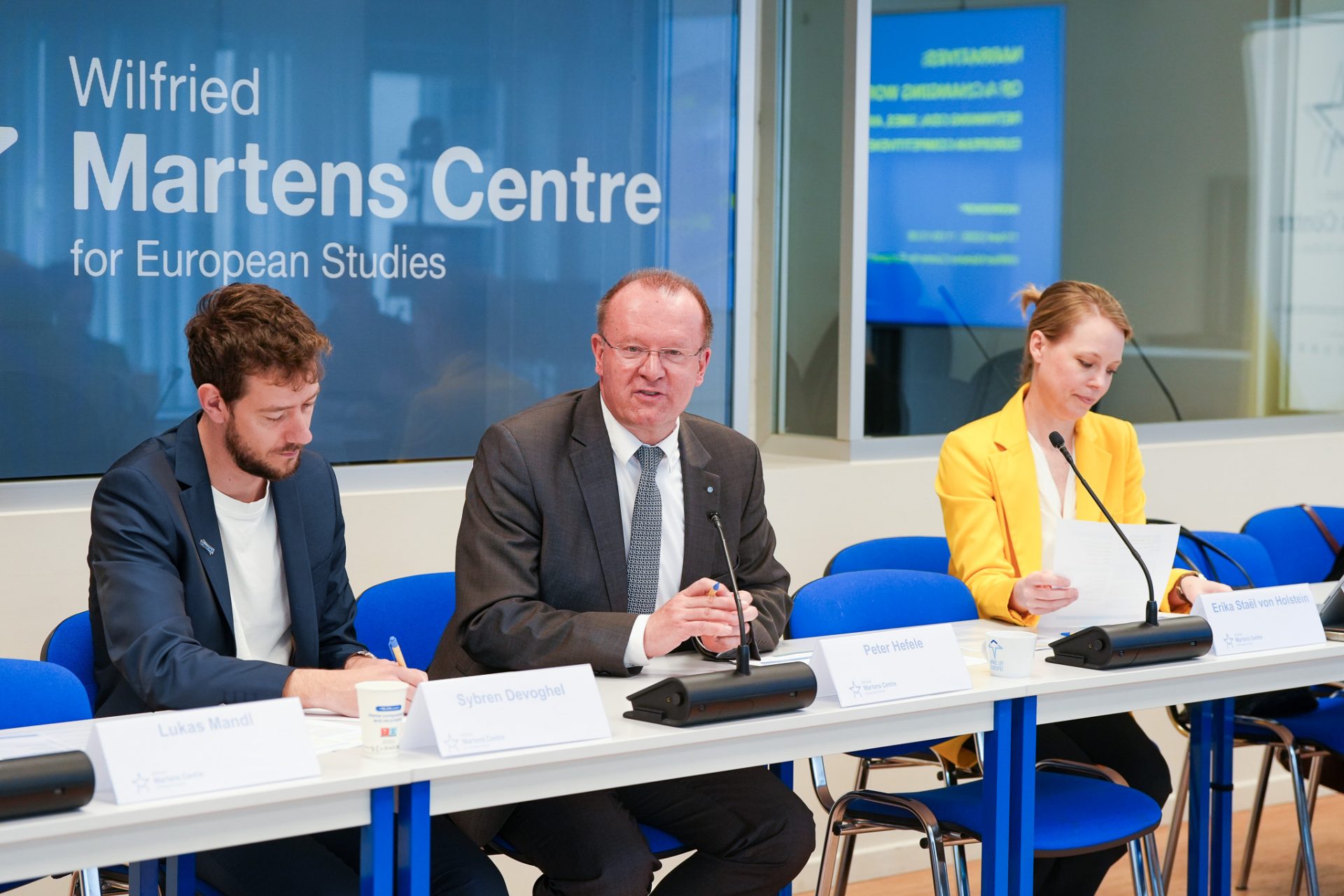
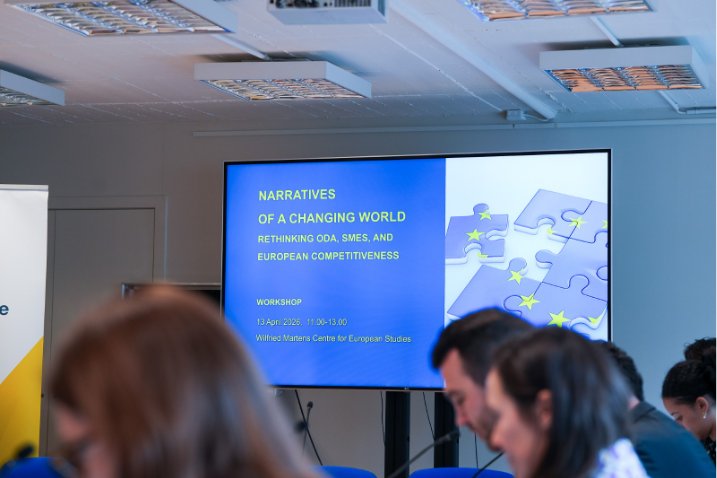
Twenty-five leaders and thinkers from politics, SMEs, think tanks and CSOs gathered last week to debate how Europe should redefine its international partnerships in an increasingly fragmented world. Hosted by the Wilfried Martens Center for European Studies, the roundtable “Narratives in a Changing World: Rethinking ODA, SMEs and European Competitiveness” focused on exploring how international cooperation itself could be a source of competitiveness through the enhancement and involvement of SMEs, the backbone of European economy. The event brought together distinguished figures such as MEP Peter Hefele, Policy Director of the Wilfried Martens Center for European Studies, and Sybren Devoghel, General Manager of Exchange.
Opening the discussion, Erika Stael von Holstein, Chief Executive of Re-Imagine Europa, contextualized the debate within the global rise of polarisation. Drawing upon the innovative REFRAME Methodology developed by the European Narratives Observatory (NODES), she highlighted the role of narratives as “mental frames” that dictate how reality is perceived and how political questions are navigated. These frames, she noted, often operate through deeply ingrained, unconscious patterns.
Referring to Re-Imagine Europa’s recent analysis of Official Development Assistance (ODA) narratives, she noted that the dominant current frameworks are ill-suited to the complexities of the modern era. She emphasised the necessity of acknowledging the role of emotions and the inherent dangers of “narrative traps” that constrain effective policy. “The limits of your narrative is the limit of your horizon”, she observed.
The theme of conceptual framing remained the cornestone of the roundtable’s discussions. Participants contended that ODA is still predominantly viewed through the outdated lenses of charity, dependency or zero-sum dynamics; perspectives that fail to reflect the realities of a more fragmented and multipolar world. Several speakers argued that such framing undermines Europe’s ability to act strategically and credibly on the global stage.
The consensus pointed toward a more visionary understanding of international cooperation: a model predicated on mutual benefit rather than unidirectional assistance. In this light, development policy should be viewed not merely as an act of solidarity, but as a robust strategic instrument designed to bolster European competitiveness, resilience, and sustainable growth, while generating tangible opportunities for partner nations.
Small and medium-sized enterprises (SME) are one of the clearest examples of this untapped potential. As the backbone of the European economy, SMEs were described as key to innovation, job creation, and the development of resilient value chains. Yet participants noted that they remain underrepresented in existing international partnership frameworks. While larger corporations are increasingly involved in initiatives such as Global Gateway, smaller businesses often continue to face administrative and financial barriers that make participation difficult. Streamlining access, dismantling bureaucratic barriers and providing more targeted support for SMEs were seen as essential prerequisites to deliver more concrete economic results.
Furthermore, the discussion challenged entrenched perceptions of partner regions, most notably Africa. Rather than defining the continent through the narrow language of instability or poverty, speakers described a landscape of immense opportunity and demographic dynamism. Shifting this narrative is seen as vital—not only to catalyse European investment but to forge more balanced and respectful partnerships rooted in mutual interest and local ownership.
The dialogue also reaffirmed Europe’s distinctive institutional strengths. While the EU may lack the reach and speed of other global players, its reliability, regulatory stability, and steadfast commitment to the rule of law remain formidable comparative advantages in an era of intense international volatility.
The roundtable ultimately underscored the need for seamless coherence between Europe’s domestic priorities and its external actions. International partnerships can no longer be treated separately from wider objectives such as the energy transition, supply chain security, and economic resilience.
The concluding message was unequivocal: Europe’s international partnerships can no longer be seen as peripheral to its strategic interests. They are fundamental to the Union’s future prosperity, security and global influence.
The challenge now lies in turning that recognition into policies, a transformation for which forging strong, reality-based narratives is imperative.