
Reimagining International Cooperation Through Narratives: Reflections from the European Parliament
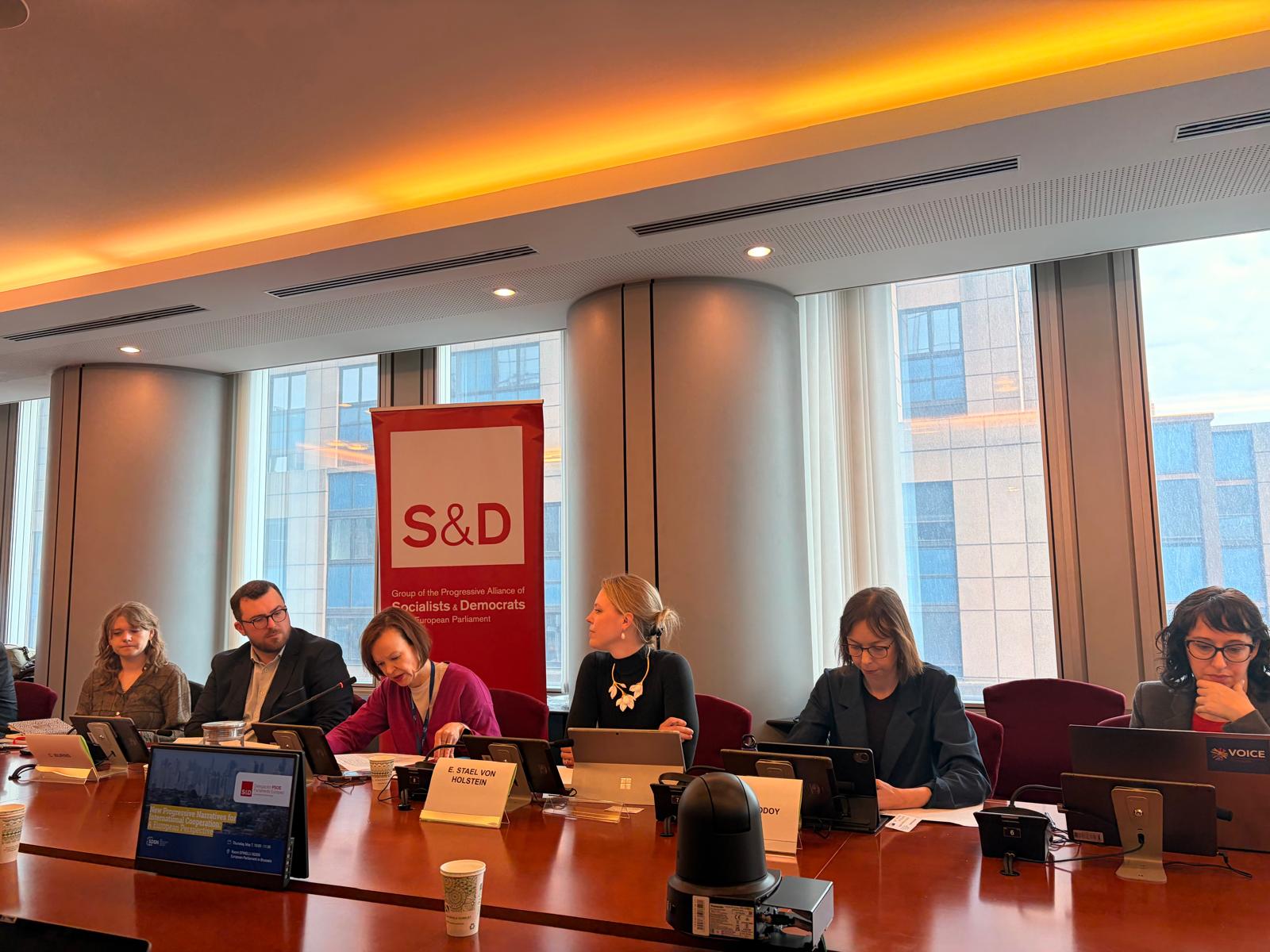
On 7 May 2026, policymakers, researchers and civil society representatives gathered at the European Parliament in Brussels for the event “New Progressive Narratives for International Cooperation: A European Perspective”, hosted by MEP Leire Pajín Iraola and co-organised with the Spanish Network for Sustainable Development (REDS-SDSN Spain). The session opened an important and timely discussion on the future of international cooperation in Europe at a moment marked by geopolitical fragmentation, disinformation, growing public distrust and increasingly polarised debates around climate, global health and development policy.
In her opening remarks, Leire Pajín Iraola stressed the urgency of holding this conversation now, highlighting the need to rethink how Europe speaks about international cooperation in a rapidly changing political and social context. She also underlined the importance of openly addressing disinformation as part of this debate, noting that misleading narratives and manipulated information increasingly shape public perceptions around development, climate action and global health. “If we want to defend international cooperation, we also need to defend the quality of our public conversation,” she noted during the discussion. In this context, discussing disinformation is not only about correcting false claims, but also about understanding how distrust, fear and polarisation can weaken democratic debate and undermine support for international cooperation itself.
Representing Re-Imagine Europa, Chief Executive Erika Staël von Holstein focused her intervention on the growing role of narratives in shaping political realities and public perception. Drawing from Re-Imagine Europa’s work on depolarisation, narrative ecosystems and disinformation, she emphasised that many of the narratives traditionally used around international cooperation were built for a different world, one that no longer reflects today’s social anxieties, emotional landscapes or political dynamics.
Her remarks explored how emotionally charged narratives increasingly shape public debate, often more powerfully than facts alone. In this context, she noted that disinformation succeeds not simply because of falsehoods, but because it connects with underlying fears, frustrations and feelings of disconnection that many citizens experience. Instead of relying on purely technocratic language or defensive messaging, she called for approaches that can rebuild trust, emotional resonance and relevance. “Rather than approaching narratives simply as tools of persuasion, we should see them as tools for listening and understanding,” she argued, emphasising that rebuilding support for international cooperation means acknowledging legitimate concerns, restoring trust across divides and developing narratives that genuinely connect with people’s lived experiences today, rather than with the assumptions of a previous political era. Her intervention ultimately highlighted the need for a new generation of narratives capable of addressing disinformation and polarisation without deepening them further, while reconnecting international cooperation to questions of security, stability, economic resilience and collective European purpose.
The discussion was followed by a presentation from Conleth Burns from More in Common on the study Europe Leads – Navigating Europeans’ Expectations for Leadership on Development. The presentation highlighted an important insight for those working in international cooperation and public policy: while a relatively small proportion of the public holds firmly positive or firmly negative positions on these issues, the majority remains movable. This underlined the importance of reconnecting international cooperation with citizens’ everyday concerns and demonstrating its relevance not only in moral terms, but also for Europe’s own economic resilience, stability and future competitiveness.
The second half of the event shifted from discussion to practice through the Narrative Resilience Lab: Countering Disinformation in Development, Climate and Global Health. Designed as a hands-on workshop, the session brought together participants from different sectors to analyse real-world disinformation cases circulating across Europe. Working in mixed groups, participants explored the manipulation techniques used within polarising narratives, while also identifying the legitimate concerns that often lie beneath them. Discussions focused on how fear, distrust, perceptions of unfairness and sovereignty concerns are frequently instrumentalised in debates around climate policy, global health governance and development cooperation.
Importantly, the workshop encouraged participants not simply to “counter” narratives, but to better understand the emotional and social dynamics that make them resonate in the first place. Through collaborative exercises, groups explored new ways of communicating across divides, building empathy toward different narrative communities and developing responses capable of addressing concerns without reinforcing polarisation. The workshop also reflected on common communication pitfalls in highly polarised environments, including overly technocratic responses, defensive framing and the repetition of opponents’ narratives. Instead, participants worked on developing alternative messages grounded in clarity, empathy and relevance to citizens’ lived realities.
The event ultimately reinforced a growing recognition across European policy and civil society spaces: rebuilding support for international cooperation cannot rely on facts and policy arguments alone. It also requires narratives capable of reconnecting with people emotionally, addressing legitimate anxieties and creating a renewed sense of collective purpose in an increasingly uncertain world.