State of the Union – the critical points
By Maria João Rodrigues, Chair of Re-Imagine Europa’s Advisory Board.
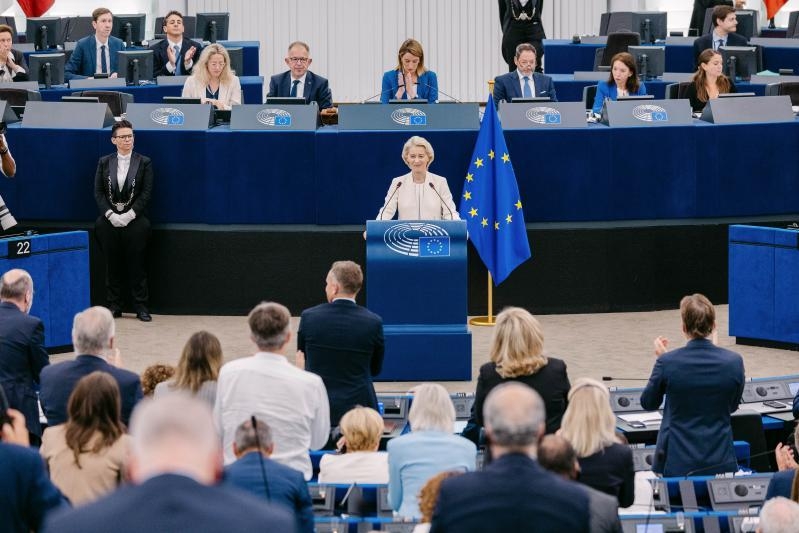
Von der Leyen was right at the start of her State of the Union speech. For a long time now, the European project has not faced a context as difficult as this one. Major-scale changes are underway: climate and digital transformations. Externally, we face a world order in disintegration, with long-lasting military conflicts, trade wars, and a weakened multilateral system. Internally, we are seeing the rise of political forces hostile to the European project. Some ambitious initiatives were announced. But will their ambition be enough?
First, a Europe with greater geopolitical ambition. In the face of the trade war triggered by the Trump administration, Europe has been signing new trade agreements, establishing itself today as the world’s leading trading power. Adding new networks across Central Asia and the Mediterranean, raising Canada’s status, and also associating Norway and the United Kingdom in a security council makes sense. But a strong commitment to the multilateral system was missing. At a time when it is being pushed by forces of fragmentation, the European Union has a particular responsibility: to defend it and reform it.
Regarding the new round of EU enlargement, it was good to be reminded that it should be based on criteria of merit – on the transformation that candidate countries must carry out. Sooner rather than later, the EU will have to confront an unavoidable historical question: how to deepen before expanding? The Congress on the Future of the EU proposed by Von der Leyen should serve to prepare this new phase of the European project. In any case, it should also act as a catalyst for the forces that sustain it—particularly during the next election year, when opposing forces will do everything to secure positions of power in some of Europe’s largest countries: France, Spain, Italy, and Poland, as well as in various German regional states.
On the geoeconomic front, Europe will have to re-evaluate and renegotiate its relationship with China. The trade imbalance was already worrying, but it is set to worsen because China has become more competitive not only in green transformation but also in the digital realm. Since Europe is also committed to these two transformations, it will have to make a major choice: either accept growing dependence on China in terms of imports and technology, or rapidly strengthen its own capacity. To do so, Europe must openly assume the need for an industrial innovation policy – something it hesitated to embrace for decades.
This issue is particularly acute when it comes to digital transformation. Europe cannot be trapped in the rivalry between the United States and China. It will have to develop its own path toward digital sovereignty, while promoting more international cooperation.
The moment when the race for the foundational models of AI is at full speed is also a moment when Europe should demand guardrails for the risks they entail—but also show that AI can be developed through other paths that are more respectful of the environment and of people, such as consumers, workers, and citizens. It is not enough to use industrial AI across multiple sectors where Europe has experience and quality data, as Von der Leyen rightly pointed out. It is necessary to develop demand for European products and services, to create the fundamental market pull that will stimulate European companies to offer new solutions aligned with the European way of life. This will also make it possible to create new jobs and manage professional transitions with less tension and fewer exclusions. Ultimately, what is at stake is inventing a new development model that leverages digital transformation. Here, Europe can “set the pace”—and the turtle can overtake the hare.
The digital issue has also become central to the future of democracy. Von der Leyen mentioned the Democratic Resilience Centre already announced. But it is not enough to defend our media ecosystem from disinformation and distortion operations. A new critical infrastructure must be created so that quality media can reach broader audiences in different languages.
Von der Leyen chose not to mention a central issue that will be at the heart of the negotiations until the end of this year: an ambition without an agreement on the budget for the coming years is not credible.
We need another narrative. If Europe wants to secure a future in a world that is far more challenging, hostile, and divided, it will have to go beyond the usual arguments between net contributors and net beneficiaries—and recognize that a budget capable of sustaining ambition requires new own resources. For example: if an increasing share of value added will be generated by the digital economy, it makes perfect sense that it should contribute proportionally to the EU budget—especially since it is the first to benefit from the large single European market.
This Op-Ed was originally published in Portuguese in Público.pt on 09/17/2026. You can read the original here: Estado da União: os pontos críticos