
Digital with Purpose Summit: Building a Digital Transformation that People Can Trust
How can Europe build an AI future that delivers for businesses, citizens and the environment? And what role do the stories we tell about AI have in that future? Across two days in Brussels, Re-Imagine Europa brought together research on the narratives shaping AI and expert discussions on the practical choices ahead.
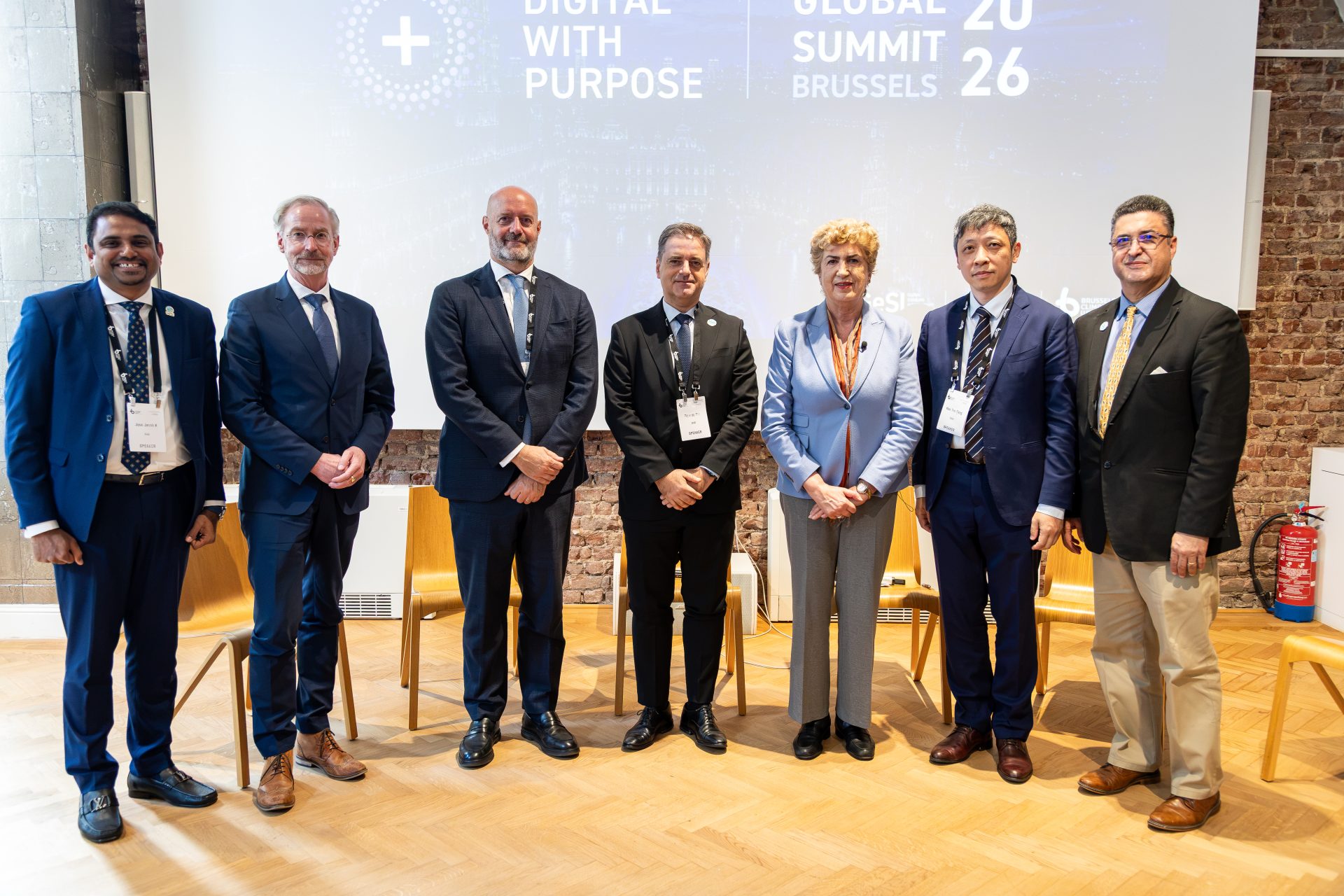
On 12 October, Re-Imagine Europa joined policymakers, industry leaders, and international experts at the Digital with Purpose Summit (GeSI), hosted at the Maison de la Poste as part of Brussels Climate Week. Addressing the Summit’s core focus on the infrastructure and business foundations of Europe’s AI ambitions, RIE brought two closely connected perspectives to the discussion: how AI ecosystems can be harnessed to address systemic societal challenges, and how the underlying stories surrounding technology influence public trust, policy, and capital allocation.
Opening the day, Maria João Rodrigues, Chairwoman of Re-Imagine Europa and Coordinator of the Global AI Impact Network (GAIN), set the vision in her keynote address. She framed AI not merely as a technological frontier, but as a catalyst for European renewal, calling for a bold alignment of market demand, digital infrastructure, and public-private investment. Grounded in initiatives like the Global AI Impact Network, her vision charts a path toward a competitive, inclusive, and sustainable digital future powered by purpose-driven international partnerships.
Later in the program, Rodrigues moderated an international roundtable on twin digital and sustainable transformation that translated this high-level ambition into a practical roadmap. Moving from vision to global strategy, the panel explored distinct AI development models across Europe, Asia, and the Americas. Bringing together leaders from GeSI, the World Bank, and industry, the discussion reinforced a central thesis: Europe does not need to replicate foreign models such as US venture innovation, China’s industrial application, or India’s digital inclusion, but rather build on its own strengths in industrial expertise, values-based regulation, and sustainability. Key priorities highlighted include scaling SME adoption, aligning AI with decarbonization, and leveraging international partnerships through GAIN to shape a competitive, inclusive digital economy.
What the Stories about AI Reveal
Presenting preliminary findings from GAIN’s research on the discourse shaping the AI debate, RIE Chief Executive Erika Stäel von Holstein delivered an intervention titled The Stories That Will Govern AI. The research analyzes how AI is conceptualized across public discourse and strategic policy frameworks, identifying seven recurring core narratives—ranging from AI as an existential threat or a geopolitical race, to AI as an everyday tool, an ecosystem to cultivate, or a quintessential European project.
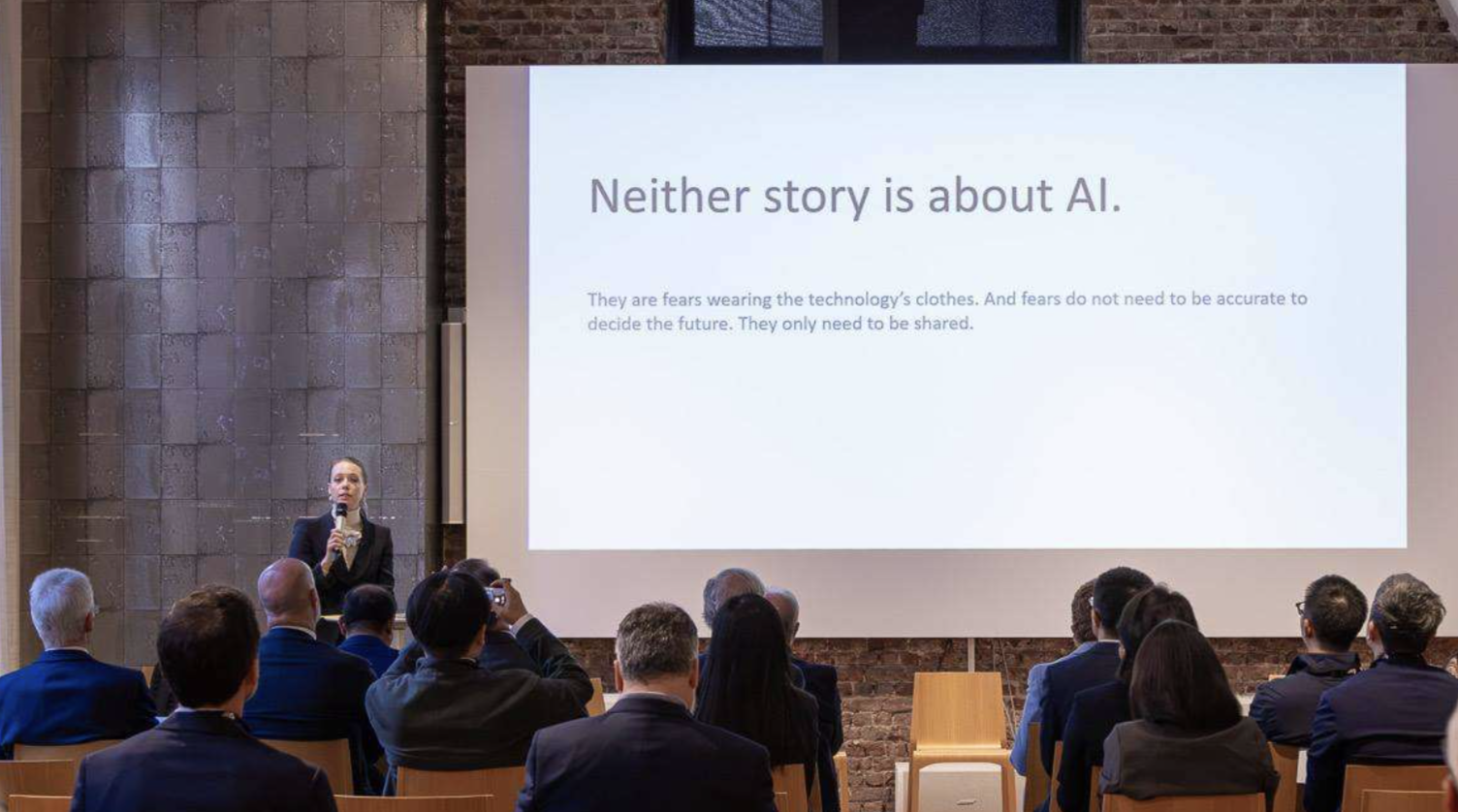
Initial findings reveal that frames portraying AI as an unstoppable force or an imminent threat currently dominate public awareness. These frames matter deeply: a promise of economic growth or job creation offers little reassurance to communities concerned about energy consumption, resource allocation, or their ability to shape their own futures.
Stäel von Holstein’s presentation underscored the imperative of listening to the deeper emotional and cognitive concerns beneath these surface narratives. To build lasting public trust, Europe’s AI agenda must be explicitly linked to benefits that citizens can recognize in their daily lives—placing human agency, shared values, and democratic accountability at the core of technological progress.
From Insight to Action: The GAIN Expert Group
Building on these narrative insights, the following day RIE hosted a GAIN Expert Group meeting, shifting the discussion to practical choices. Bringing together leading voices across disciplines, the meeting drew on a wide reservoir of expertise to connect technological, economic, and social dimensions.
Discussions connected the practical foundations of digital transformation – including infrastructure, skills, investment and governance – with questions of public trust and societal benefit, carrying forward the reflections of the previous day. Members also considered the value of international exchange and practical examples in developing recommendations that respond to the needs of policymakers, businesses and communities.
Participants included Nicola Villa, Senior Strategic Partnerships Advisor for Digital & AI at the World Bank Group; Jean-Pierre Kempeneers, Co-founder of P4, Public-Private Partnerships with People; Jan Kuenne, Managing Chairman and CEO of the Grundig Akademie Group; Blaž Golob, Chairman of the GFS Institute; Luca De Biase, journalist, author and expert on innovation and digital culture; Sarah Nicole, policy and technical governance specialist and lecturer at Sciences Po; and Andrzej Nowak, Professor of Psychology at the University of Warsaw and Florida Atlantic University and RIE’s Chief Narrative Scientist, Tom Moran, Senior Advisor and expert in technology, sustainability and digital transformation, as well as two members of RIE’s in-house team – Pietro Morandini, independent economic consultant, and Bernd Halling, Senior Political Advisor at Re-Imagine Europa. They were joined by GeSI CEO Luis Neves and Head of EMEA and Strategic Partnerships Ricardo Rio.
By connecting the material foundations of digital transformation with the cognitive frames that govern public perception, the two-day gathering advanced preparations for GAIN’s upcoming policy report. Further expert contributions and drafting will continue over the coming months.
As this report takes shape, Re-Imagine Europa will continue collaborating with GAIN’s experts and partners—ensuring that Europe’s digital transformation is anchored in the trust, dignity, and collective ambition of the people it is meant to serve.