Reframing Official Development Assistance to foster European Global Competitiveness
In a world defined by deep fragmentation and profound social, economic, and geopolitical transformations, Europe is under growing pressure to redefine its role in the world. At the same time, Official Development Assistance (ODA) is facing increasing scrutiny, often framed as a moral luxury that Europe can no longer afford amid domestic pressures—an outdated and harmful framing designed for a world that no longer exists.
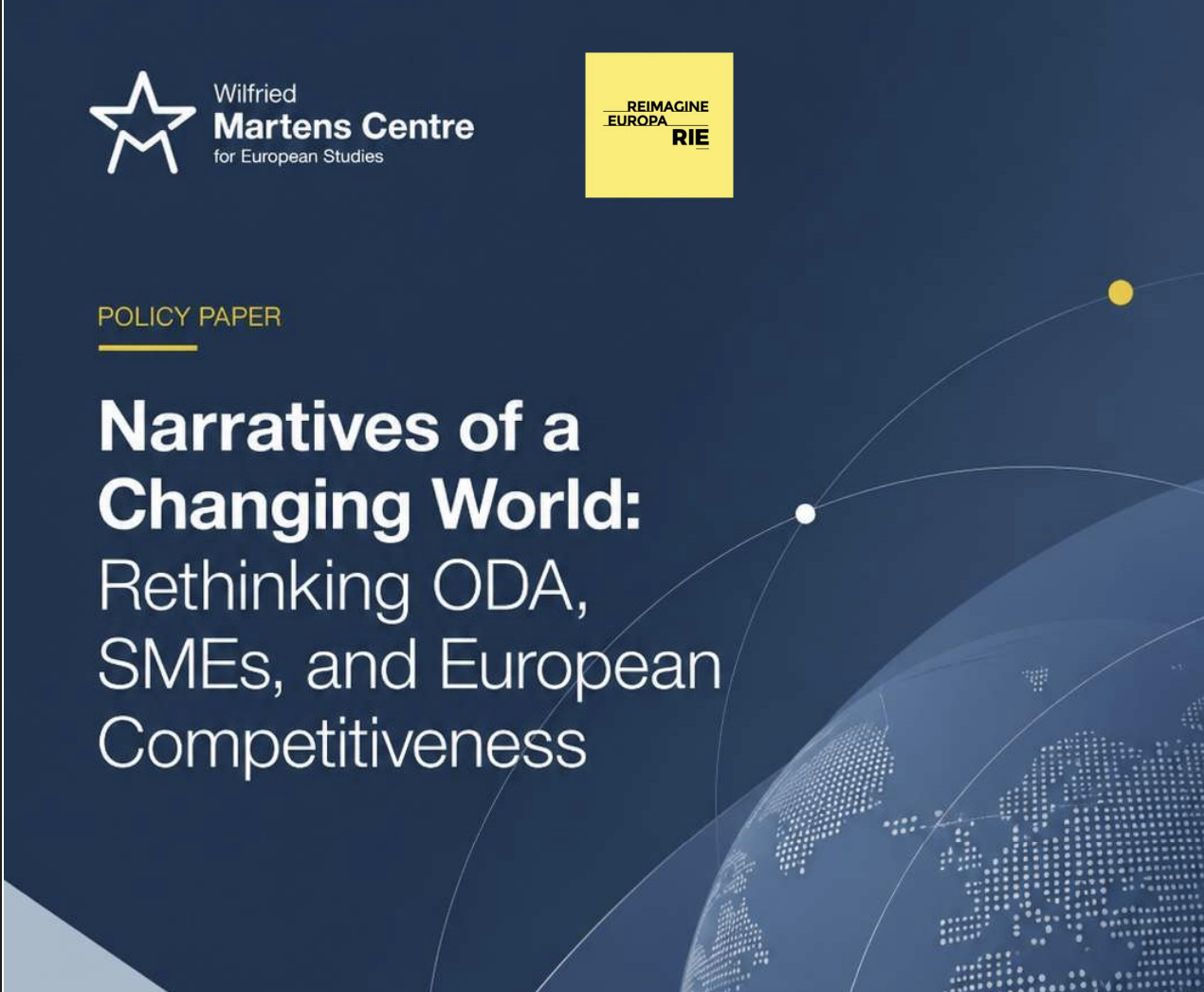
A new policy paper published jointly by Re-Imagine Europa and the Wilfried Martens Centre for European Studies proposes a fundamental narrative and operational shift: transitioning Official Development Assistance (ODA) from a traditional framework of unilateral solidarity toward a strategic pillar of partnership, competitiveness, mutual prosperity and economic security.
The paper “Narratives of a Changing World: Rethinking ODA, SMEs, and European Competitiveness,” co-authored by Anna Widegren and Peter Hefele, builds upon extensive institutional research and the insights generated during the high-level roundtable “Narratives in a Changing World: Rethinking ODA, SMEs and European Competitiveness” hosted on 13 April 2026 by the Wilfried Martens Center for European Studies.
The document shows how the post-Cold War assumptions underpinning international cooperation are increasingly strained by global fragmentation, technological acceleration, and systemic competition. As the Re‑Imagine Europa analysis shows, framing development cooperation through the lens of charity, moral duty, or humanitarian solidarity risks triggering zero‑sum perceptions in citizens under economic strain, fueling polarization, as domestic hardships make international spending politically harder to justify. Rather than relying on these traditional frameworks, the authors argue that Official Development Assistance (ODA) must be conceptually integrated into Europe’s broader agenda for strategic autonomy and industrial resilience.
Development cooperation should be repositioned as a two-way partnership that fosters not only mutual prosperity but also competitiveness, security, and resilience. A central thesis of the paper is the critical, yet underutilized, role of Small and Medium-sized Enterprises (SMEs) in fostering sustainable, bilateral economic ecosystems. While SMEs constitute 99% of European businesses and generate two-thirds of private sector employment, existing international development mechanisms, including the Global Gateway framework, inherently favor large multinational actors due to administrative scale and regulatory complexity.
Strategic recommendations
To rethink ODA credibly, Europe must move beyond inherited aid categories and
articulate a more strategic, partnership-based narrative in which SMEs play a visible role. That
requires three concurrent actions:
– Narratively reposition ODA as a strategic investment for prosperity, security and resilience
rather than as charity;
– Adapt instruments — particularly Global Gateway modalities — to be SME friendly by
lowering administrative burdens, offering targeted guarantees and combining working
capital with technical assistance;
– Communicate measurable outcomes that show local jobs, market creation and supply-chain resilience to domestic audiences.
As highlighted during the April 2026 Roundtable, Europe’s credibility will depend on its capacity to demonstrate that development cooperation is a pragmatic, win-win tool that strengthens European competitiveness and supports partner country agency. Policymakers who act on this insight can preserve ODA’s political space, catalyze SME-led growth, and secure Europe’s long-term strategic interests.
As the authors state, the future of ODA should not be framed as sacrifice. Instead, it must be seen as a vital investment in a more resilient, competitive, and interconnected future for Europe and its partners alike.